Updated: July 15, 2026. Road signs, markings, signals and penalty standards may change.Always follow the latest official announcements and on-site instructions..
Two-stage left turns are only the first of Taiwan’s scooter rules to learn. Restricted lanes, when to enter a waiting box, passenger posture, cargo dimensions and riding through arcades are the details most likely to confuse first-time riders.
The first question foreign friends ask when getting on a scooter in Taiwan is often not “Where can I rent one?” but “Why does everyone turn left differently?” Some intersections allow a direct left turn, while others require riders to use a waiting box. The rider next to you moving forward does not mean you may do the same. The basic rule is simple: read the signs, road markings and signals first, then decide which lane and turning method apply.
If you have not yet confirmed your international driving permit and vehicle-class eligibility, first readour licence and safety guide for foreign scooter renters. If you only need to get around a major city, you can also comparehow to use the Taipei Metroorhow to use EasyCard. Riding after you understand the local traffic is usually much easier than starting on your first day in Taiwan.
Read the intersection first: waiting boxes, lanes and red lights
At an intersection, signs and road markings take priority. If the inner lane is marked “No Scooters,” you may not make a direct left turn from that lane and must use a two-stage left turn. The absence of that marking does not allow you to cut suddenly into any lane. Under Article 99 of the Regulations Governing Road Traffic Safety, scooters must still use the permitted lanes when no other signs are present, and riders changing lanes must yield to traffic going straight.
For a two-stage left turn, ride straight into the waiting box on the far right while your original direction has a green light. Turn the scooter to face the next direction, then wait for that signal to turn green. A waiting box is not permission to cross the stop line during a red light just to “wait over there”; entering the intersection on red may count as running a red light.
| Common rule | Possible fine | Example |
|---|---|---|
| Making a direct left turn where a two-stage turn is required | NT$600–1,800 | The inner lane is marked “No Scooters,” but the rider enters it and turns left directly. |
| Crossing the intersection into a waiting box on red | Running a red light: NT$1,800–5,400 | The waiting box on the far right has space, so the rider crosses the stop line during a red light to enter it. |
| Riding a scooter outside the permitted lanes | NT$600–1,800 | The rider enters an inner lane marked “No Scooters” to overtake. |
| Riding on a sidewalk or through an arcade | NT$600–1,800 | The rider uses an arcade to bypass congestion and continues to the next intersection. |
The easiest mistake is assuming that what another rider does must be legal. Some large heavy motorcycles generally follow passenger-car rules, and some intersections have dedicated motorcycle left-turn lanes. Different vehicle classes and local controls produce different routes. The Ministry of Transportation’sguide to two-stage scooter left turnsalso reminds riders to follow the signs, markings and signals at each intersection.
Passengers, cargo and helmets: fitting does not make it legal
A standard heavy or ordinary light scooter with a fixed rear seat may carry only one passenger, and the passenger may not sit sideways. Once carrying a passenger, the rider generally may not also carry large items that affect safety. Small light scooters may not carry passengers. If you are unsure of the vehicle class when renting or borrowing, check the vehicle registration instead of judging by size alone.
A helmet is not properly worn merely because it is on your head. It should carry an inspection mark, have all parts intact, face forward and be fastened under the chin. If a passenger leaves the strap undone, the driver is still the person fined. Cargo is restricted by both weight and dimensions: up to 20 kg on a small light scooter, 50 kg on an ordinary light scooter and 80 kg on a heavy scooter. It may not rise above the rider’s shoulders, extend more than 10 cm beyond either handlebar edge, or project more than 50 cm behind the rear axle.
| Common rule | Possible fine | Example |
|---|---|---|
| Overloading, sideways seating or unsafe cargo | NT$300–600 | A standard scooter carries two passengers, or a passenger sits with both legs on the same side. |
| Driver or passenger not wearing a helmet correctly | NT$500 | The passenger wears a helmet but does not fasten the chin strap. |
| Cargo exceeds weight or dimension limits | NT$300–600 | A long board is placed across the rear seat and extends 30 cm beyond each handlebar edge. |
Article 88 of the Regulations Governing Road Traffic Safety is detailed for a reason: passengers and cargo affect a scooter’s balance, steering and braking. If luggage blocks the mirrors, indicators or movement of your feet, a taxi or public transport is usually more practical. For intercity travel, first seeTaiwan High Speed Rail Guide, then arrange short local connections after arrival.
Parking, mobile phones and modifications: stopping can still break the rules
Taiwan’s sidewalks and arcades often appear packed with parked scooters, but parking is permitted only where the authority has installed spaces, signs or markings. Following other parked scooters where there are no marked spaces can still lead to a ticket or towing. To move a scooter into a legal space, dismount, switch off the engine and push it rather than riding along the sidewalk.
Holding a mobile phone while riding to call, message or check a map carries a NT$1,200 fine. Even at a red light, if the scooter is still part of moving road traffic, testing the legal boundary is not worth a ticket. Pull over at a legal place that does not obstruct traffic before changing navigation settings.
Exhaust modifications also require registration. An unreported non-original exhaust may be fined at twice the statutory maximum, up to NT$3,600, and the vehicle may be ordered to undergo inspection within the deadline. Removing a silencer or otherwise creating excessive noise may trigger additional penalties. Buying a part does not complete the legal process; confirm specifications and registration requirements with a motor vehicles office before modifying the scooter.
| Common rule | Possible fine | Example |
|---|---|---|
| Illegal parking | NT$600–1,200, plus possible towing and storage | There are no marked scooter spaces on the sidewalk outside a metro station, but the rider parks beside other scooters. |
| Holding a mobile phone while riding | NT$1,200 | The rider slowly rolls forward while holding a phone to check navigation. |
| Failing to report a non-original exhaust | Up to NT$3,600, plus a required inspection | The rider installs a replacement exhaust and rides without completing the required change registration. |
Fine amounts are statutory ranges under the Road Traffic Management and Penalty Act. The amount in an individual case still depends on the violation, vehicle class, payment deadline and applicable penalty schedule. Read the full text in theRoad Traffic Management and Penalty ActandRegulations Governing Road Traffic Safety. If you remember only one thing before setting off, read the road markings first, then the signs and signals. When unsure, continue to the next intersection and replan instead of changing lanes suddenly.
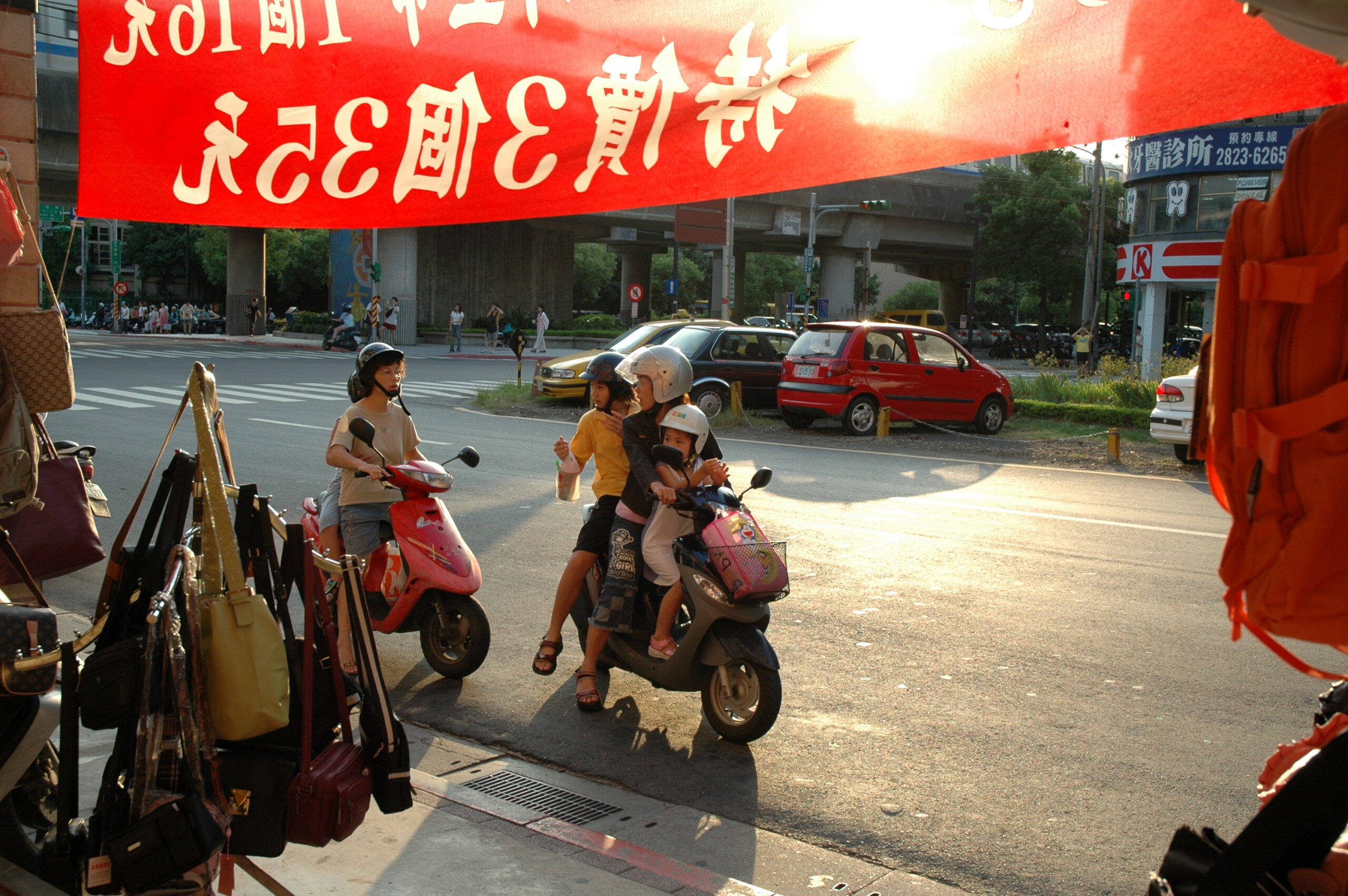
To compare other ways of getting around, start with ourTransport Guide. For planning a first trip, return to ourTaiwan Travel Guide. The featured image shows scooters on a Taipei street; photograph by Siyad Ma,CC BY 2.0.
Leave a Reply